Original sin
The SympathizerOriginal sin is a religious teaching that becomes, for The unnamed narrator, a personal explanation of guilt and a troubling way to connect childhood discipline with adult violence. Learned from The Father, who was also his biological father, the doctrine insists that guilt is inherited; the narrator repeatedly measures that claim against children who have done nothing, his own history of being marked as unnatural, and the possibility that killing carries a sacred weight. Rather than settling whether anyone is innocent, the idea exposes how readily inherited guilt can make punishment seem just.
Doctrine and the Father’s Classroom
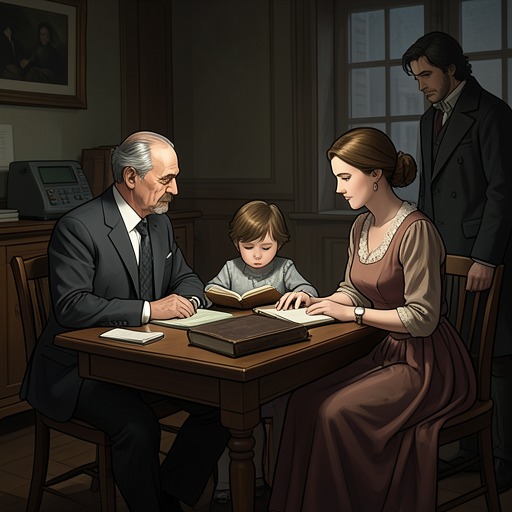
As a boy, The unnamed narrator attended lessons for the children of the diocese because The narrator’s mother made him go. In the schoolroom, The Father taught him the Bible, the history of his divine Father, the story of his Gallic forefathers, and the catechism of the Catholic Church. One catechism question asked what sin people inherit from their first parents; the prescribed answer was Original Sin. The formula gave inherited guilt a precise place in the boy’s religious education, presented as a lesson to be learned along with scripture and church history.
That teaching changed in meaning when the boy learned that the priest instructing him was also his own father. At eleven, a classmate’s taunt about his parentage turned the abstract lesson of inheritance into a public judgment of his body and identity. The boy understood himself through the jeering image of a creature neither dog nor cat, neither human nor animal. He punched the classmate repeatedly, and the gathered children watched, shouted, and laughed. The episode makes guilt more than a doctrine transmitted through religious instruction: it is also a stigma imposed by other people, answered in the moment with physical violence.
Afterward, The unnamed narrator went home in confusion and wept to The narrator’s mother. She told him he was not unnatural and disclosed the circumstances of his parentage. She had been The Father’s young maid; he had taught her to read and count in his language, and they had spent evenings together reading and sharing stories. She interpreted what had happened between them through religious belief, telling her son that God had a role for him in a Great Plan and that he had a destiny. Her reassurance reframed the boy’s perceived illegitimacy as purposeful rather than shameful, but it did not erase the force of the revelation: he had to confront his father’s identity and say goodbye to childhood.
Inherited Guilt and the Problem of Innocence
The doctrine later becomes a lens through which the narrator considers children far younger than the age at which he learned it. After promising to care for The crapulent major’s widow and children, The unnamed narrator looks at her sleeping one-year-old twins. Their mother sees them as her joy and as what keeps her alive; he offers the compliments she wants, though his private response is less certain. He is not an admirer of children and thinks of his own childhood cohort as generally despicable. Yet he recognizes that the twins are still unconscious of their guilt, likening them to new immigrants who have only just entered the world.
That distinction gives the scene its moral tension. The twins have not yet become conscious of guilt, but the narrator wonders how long they can remain unaware of it and whether each might already, however briefly, have wished for the other to disappear. He imagines rivalry and future wrongdoing without claiming that the babies have committed anything. The doctrine’s language of inheritance thus hovers over the children before any particular act: it makes guilt seem to precede conscious choice, while their helpless sleep makes the idea difficult to accept without unease.
His own childhood supplies a harsher example of how inherited guilt can justify punishment. The unnamed narrator recalls that The Father struck students’ knuckles with a ruler, leaving them bruised purple, blue, and black. Sometimes the children deserved punishment and sometimes they did not. When evidence showed that a student was innocent, The Father still showed no regret, because the premise that everyone inherited Original Sin made even a wrongly administered punishment seem, in some way, just. In this recollection, the doctrine does not merely explain human imperfection; it helps sustain a system in which innocence offers little protection from pain.
Sin, Violence, and Moral Permission
The narrator’s account of punishment connects religious inheritance to a broader culture of corrective violence. He describes Bon threatening shoplifters with a baseball bat until they surrendered what they had taken and begged forgiveness, then compares this lesson in force with the corporal punishment through which children and students had been disciplined. His memory of The Father’s ruler makes the violence in the shop a continuation of a familiar logic: wrongdoing calls for punishment, but universal guilt can make even an unjust blow appear deserved. This is the narrator’s reflection on how punishment is learned, not a claim that the doctrine makes every act of violence inevitable.
The narrator’s response to the idea of sin is not simple piety. He says his mother’s sin seemed unoriginal to him and suspects that any sin he might commit while courting Lana would also fail to be original. His attention to originality complicates the inherited moral scheme: he is not only asking whether an act is sinful, but whether it can be distinguished from the familiar patterns of sin and desire. Religious language remains present in his thinking, including the Apostles’ Creed, but it does not furnish an uncomplicated route from belief to moral certainty.
The sharpest extension of the concept comes when The unnamed narrator considers killing. Bon offers to kill for him, but the narrator refuses the offer, reasoning that he must cross the threshold between those who have killed and those who have not. He searches for a sacrament appropriate to that passage and questions why none exists if killing is a sacred matter that should be acknowledged. Recalling the catechism’s account of humanity as made in God’s image, he concludes that human beings would not be killers if God were not one as well. The thought does not prove that murder is right; it reveals the danger and force of using theological language to make killing intelligible as a human, perhaps even sacred, act.
The Concept’s Unresolved Force
Across these episodes, Original Sin functions less as a settled explanation than as a recurring test of what guilt means. The boy learns it as doctrine, experiences inherited shame through the revelation of his parentage, and receives his mother’s counter-reading that his existence belongs to a divine purpose. As an adult, he applies the same idea to sleeping infants, to punishments imposed on children regardless of innocence, and to the moral passage into killing. Each use shifts the emphasis: guilt can be inherited, assigned by others, or used to defend punishment, while innocence remains difficult to recognize and protect.
The concept’s deepest contradiction lies in its capacity to acknowledge universal fallibility while weakening the distinction between guilt and innocence. If everyone is already guilty, punishment can be defended even when a child did not commit the act attributed to him; if human beings inherit a nature capable of violence, killing can be placed within a theological account rather than treated as an inexplicable exception. Yet the narrator’s unease persists. The twins’ sleeping faces, his childhood humiliation, and his hesitation before taking on the identity of a killer keep the doctrine from becoming a final verdict. Original Sin explains the moral inheritance he has been given, but it does not resolve what he owes to the people who bear its consequences.